

Introduction
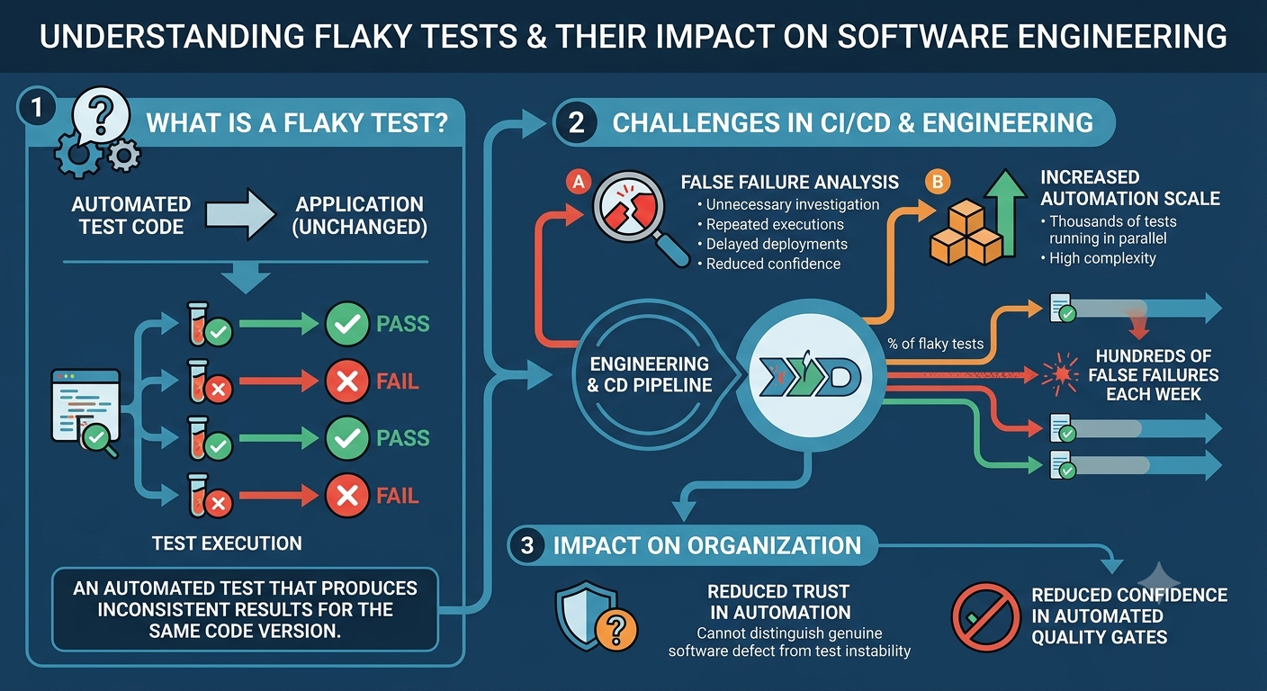
Automated testing is a part of Agile, DevOps and CI/CD practices. However as test suites grow teams often encounter flaky tests. Tests that fail sometimes and then pass without any changes to the application or test code. Flaky tests create uncertainty in automation pipelines. A failure may indicate an application defect but it may also result from timing issues, test data, infrastructure, network conditions or external dependencies. QA engineers and developers can therefore spend time rerunning tests and analyzing logs instead of addressing actual defects. AI can help address this challenge by analyzing test executions and identifying patterns that are difficult to detect manually. By combining test results with execution times, logs, environment information, screenshots and other diagnostics AI can help teams identify flaky tests prioritize investigations and suggest likely causes. This article explores the causes of flaky tests how AI can help detect and analyze them and the engineering practices required to prevent them.
Understanding Flaky Tests is important. Flakiness rarely has a single cause. It can result from synchronization problems, dynamic application behavior, environmental differences, shared test data, external dependencies or interactions between tests running in parallel.
FlakyTest
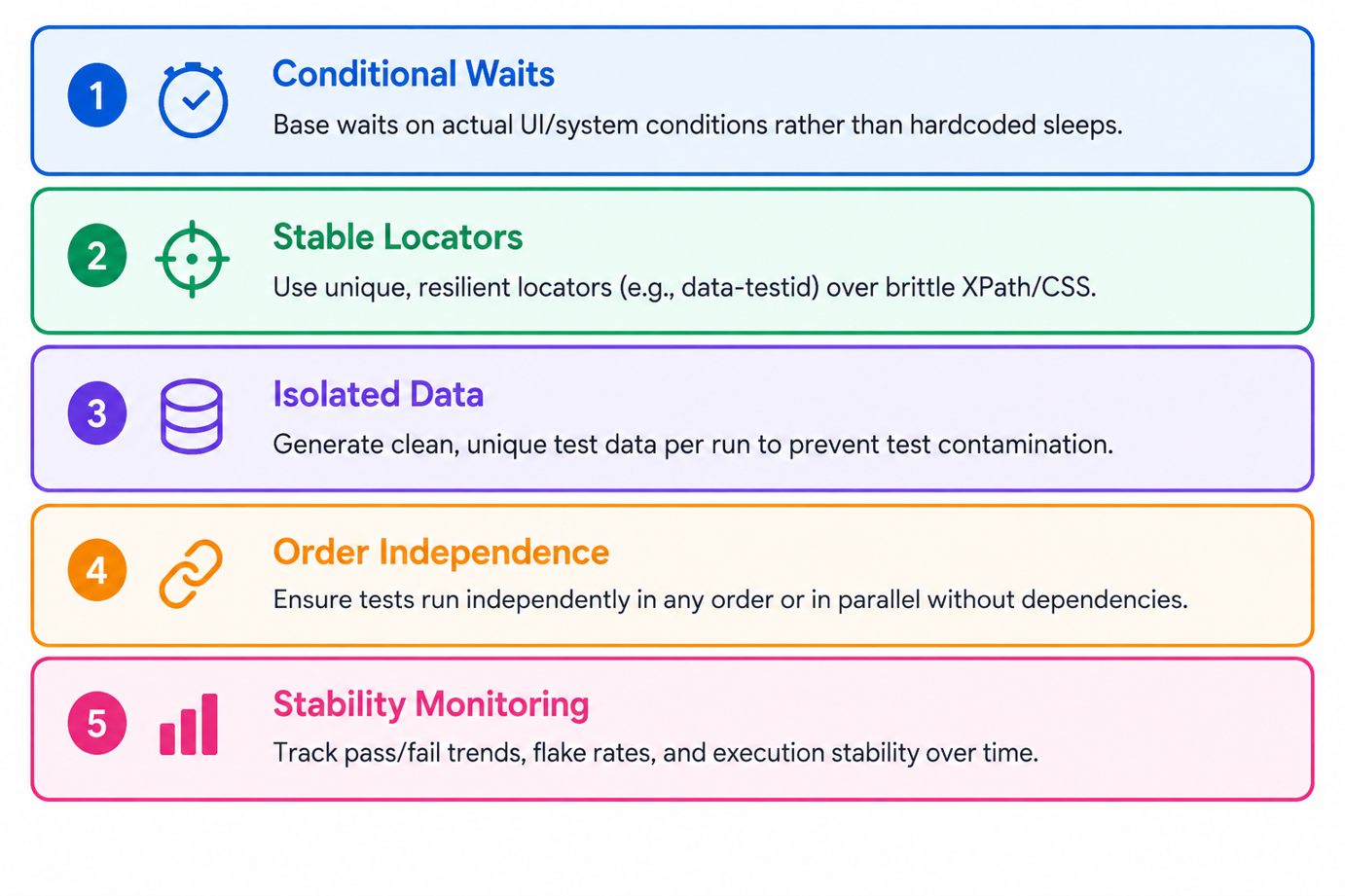
1. Synchronization and Timing Problems are common. Modern applications perform operations asynchronously including API calls, database operations, background jobs and UI rendering. A test may attempt to interact with an element before the application has finished rendering it. For example a test that clicks a “Submit” button after navigating to a page may fail sometimes if the page sometimes takes longer to load. A common but unreliable solution is a hardcoded delay. Instead tests should use condition-based waits that wait for a meaningful application state, such as an element becoming visible and enabled or an API response being received.
2. Dynamic User Interfaces and Fragile Locators can also cause tests. Modern web applications built with frameworks such as React, Angular and Vue frequently update the DOM as users interact with the application. However these frameworks do not automatically make tests flaky. The problem generally occurs when tests depend on implementation details, such as automatically generated CSS classes changing DOM hierarchies or dynamically generated IDs.
For example a locator based on a DOM path may break after a minor UI change even though the underlying functionality remains unchanged.
3. Environmental Variability is another factor. Tests can behave differently depending on where they execute. Differences in network latency, CPU and memory availability, browser versions, operating systems, container resources, database performance and cloud infrastructure can all affect results.
For example, an API may normally respond within two seconds but occasionally take eight seconds under heavy infrastructure load. If a test has a five-second timeout it may fail even though the application itself is functioning correctly. Capturing environment information alongside test results helps teams identify these patterns.
4. Test Data Dependencies can also cause issues. Tests become unpredictable when they depend on persistent data.
For example two tests may use the customer account. If one test changes the customers status while another expects the status the second test may pass or fail depending on execution order.
Creating test- data resetting application state and avoiding dependencies between test cases can significantly improve test determinism.
5. Parallel Execution can also cause problems. Parallel execution reduces CI/CD execution time but can expose hidden dependencies between tests.
Two tests running simultaneously may attempt to modify the database record write to the same file use the same session or update the same resource. These race conditions can produce failures.
The Business Impact of Flaky Tests is significant. Flaky tests are not merely a QA inconvenience. They affect the software delivery process.
When teams repeatedly encounter failures they may begin rerunning tests without investigating the underlying problem. Over time this can create fatigue and reduce confidence in the automation suite.For example a CI pipeline containing thousands of tests may frequently fail because of a number of unstable tests. Developers then spend time determining whether a failure is genuine before continuing with development or deployment.
Importantly if teams become accustomed to ignoring failures that “usually pass on retry ” a genuine defect can eventually be overlooked.
The objective should therefore not be to hide tests with retries but to identify and eliminate their underlying causes.
AI-Powered Flaky Test Detection is a solution. Traditional flaky-test analysis often relies on engineers manually reviewing execution history. This becomes difficult when thousands of tests execute every day. AI can analyze data and identify relationships between failures and factors such as test duration and timeout patterns, failure and retry frequency, browser and operating-system versions API response times, infrastructure conditions, error messages, screenshots and recordings execution order and recent test-code changes.AI should not simply label every failed test as flaky. Instead it can identify patterns that indicate a probability of flakiness and provide evidence for engineers to investigate.
Historical Pattern Analysis is useful. Consider an automated CheckoutPaymentTest that has executed 500 times. Suppose it failed 24 times and 21 of those failures passed when automatically retried without any code changes.Further analysis shows that most failures occurred when the payment API response exceeded three seconds and were concentrated in the CI environment. Rather than simply reporting a 4.8% failure rate, an AI system can correlate these conditions and report that the test has a high likelihood of flakiness particularly when payment API latency is high.This gives engineers a starting point for investigation.
AI-Based Log Analysis is also helpful. Modern automation frameworks can generate volumes of logs making manual analysis time-consuming.AI and natural language processing can classify errors identify patterns and group similar failures.
For example messages such as “payment response timeout,” “payment service did not respond,”. “Request exceeded timeout” may appear different but could represent the same underlying issue.
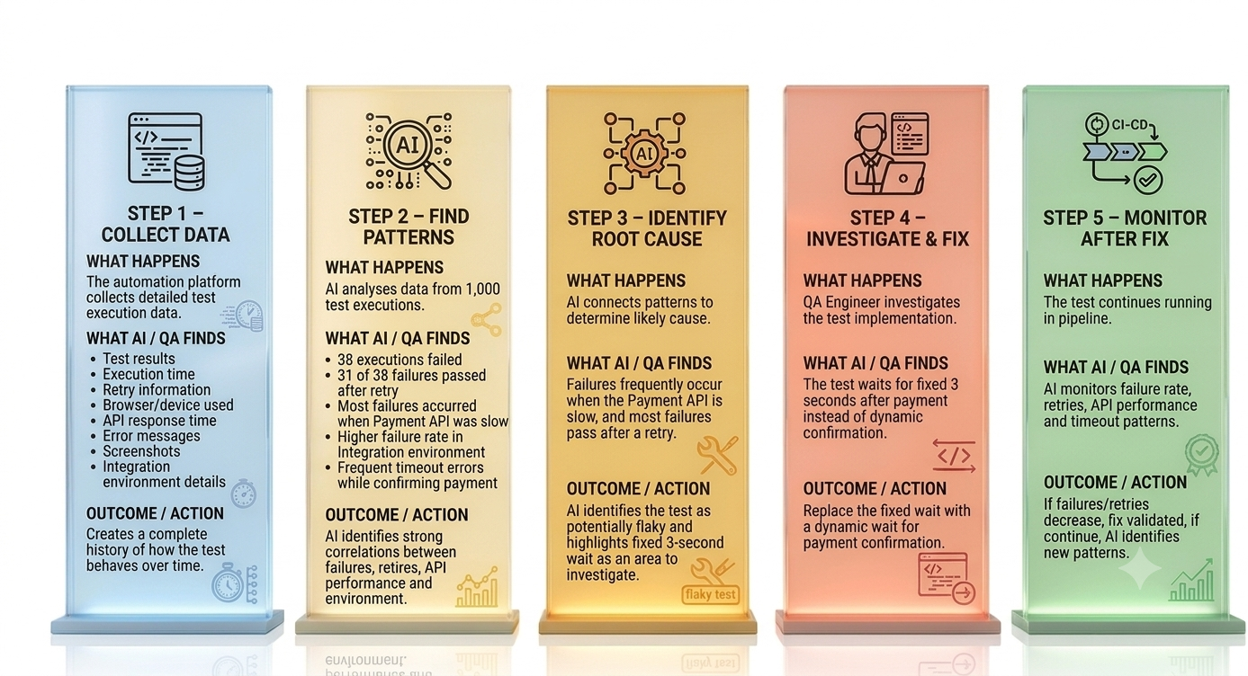
Real life example of how AI-Powered can help with a checkout test. Imagine you have a shopping application with a test that automatically checks out a product. Here’s what the test does.
Login into the application –> Adds a product to the shopping cart –> Enters the payment information –> Submits the payment –> Checks if the order is confirmed.
Now this test starts failing in the continuous integration pipeline. To fix this we need to follow some steps.
Step by Step Process
AI-Powered is most useful when it is part of the integration and continuous deployment workflow.
How AI-Powered Flaky Test Analysis Works
The test is run data is collected AI-Powered analyzes the data the failure is classified, the risk of the test being flaky is scored the engineer investigates, the test is improved and the test is continuously monitored.For each failure AI-Powered can provide:

Flaky Failure Analysis
To prevent tests AI-Powered can help identify and prioritize them.